
Hexagonal air pockets that insulate your windows instead of just covering them — the most energy-efficient shade we install. Serving The Woodlands, Spring, Conroe, Kingwood, Tomball, Cypress, Magnolia, and Montgomery since 2004.
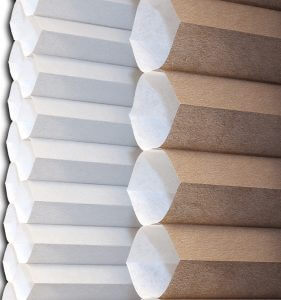
Most window treatments block heat by being solid — a thick fabric or a closed shutter panel. Honeycomb shades work differently. The fabric folds into a row of hexagonal cells that trap still air, and trapped air is a poor conductor of heat. That's the same principle behind double-pane glass, applied at the window covering instead of the window itself.
The result is the most energy-efficient shade we install — genuinely useful in a climate that runs the air conditioner most of the year and still needs to hold heat in during the occasional cold snap.
| Feature | Honeycomb Shades | Roller Shades | Solar Shades |
|---|---|---|---|
| Mechanism | Trapped air in hexagonal cells | Fabric wraps flat around a tube | Open-weave mesh on a tube |
| Insulation | Best of the three — real thermal barrier | Moderate, depends on fabric | Good — reduces heat gain |
| View through | Diffused, no direct view | Blocked or diffused by opacity | Preserved during the day |
| Best for | Maximum energy savings, privacy, glare control | Modern look, decorative fabrics | Sunrooms, view preservation |
Pleated fabric shades built with hexagonal air pockets that fold up like an accordion when raised. The trapped air inside the cells insulates the window, which is a genuinely different mechanism from a solid fabric or panel blocking heat by density alone.
Yes. By trapping still air right at the glass, they slow heat transfer in both directions — keeping summer heat out and winter warmth in — which takes real pressure off your heating and cooling system.
Single cell has one row of air pockets. Double cell has two stacked rows, creating two layers of trapped air for meaningfully better insulation and some added sound absorption. Double cell costs somewhat more.
The shade has two independent rails. Drop the top down for daylight while the bottom stays raised for privacy, or operate the bottom rail normally for a fully open or fully closed shade.
Yes, and we recommend cordless for exactly that reason. There's no hanging cord — you operate the shade by hand at the bottom rail.
Yes. An opaque inner lining inside the cells blocks the majority of incoming light while keeping the same insulating structure — useful for shift workers and media rooms as well as bedrooms.
Light-filtering fabric can show a soft silhouette at night with interior lights on. Blackout fabric blocks that completely, giving full nighttime privacy.
Gaps along the edges let air bypass the cells, which undercuts the insulating effect the whole product is built around. A tight, laser-measured inside mount is what makes the energy savings real rather than just a claim on the box.
Dust with a feather duster or a vacuum's soft brush attachment on low suction. For spots, a damp cloth with mild soap works fine.
Smaller pleats suit narrow or shallow windows and French doors. Standard pleats fit most residential windows. Larger pleats scale better on big picture windows without looking cluttered.
You choose. Domestic production runs about three weeks at a higher price. Imported production runs about eight weeks and costs less.
Yes — battery or hardwired, controlled by remote, app, or smart home schedule. Especially useful for high or hard-to-reach windows.
A roller shade blocks heat through fabric density alone. Honeycomb shades trap a layer of still air, which insulates rather than just blocks — that's why they're the strongest energy-efficiency option of the shades we install.
A limited lifetime warranty covering manufacturer's defects in materials and lift mechanisms, for as long as you own the product.
Schedule your free in-home consultation and see honeycomb shade samples in your own home.